Interview by Gabija Liaugminaitė, August 2025
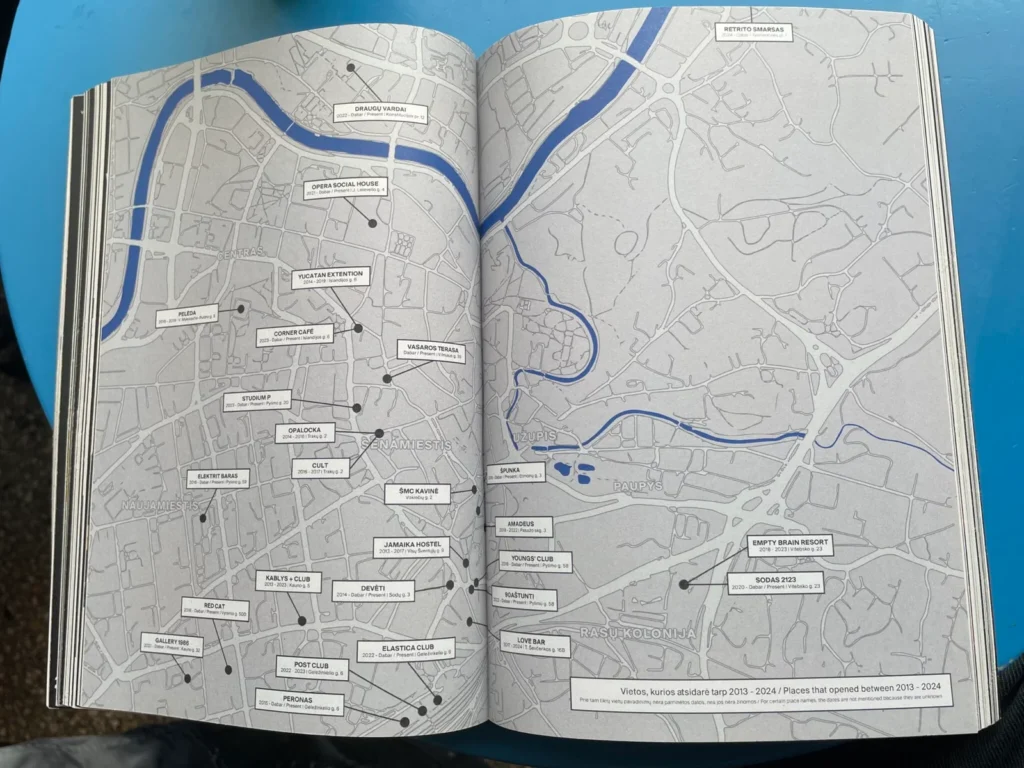
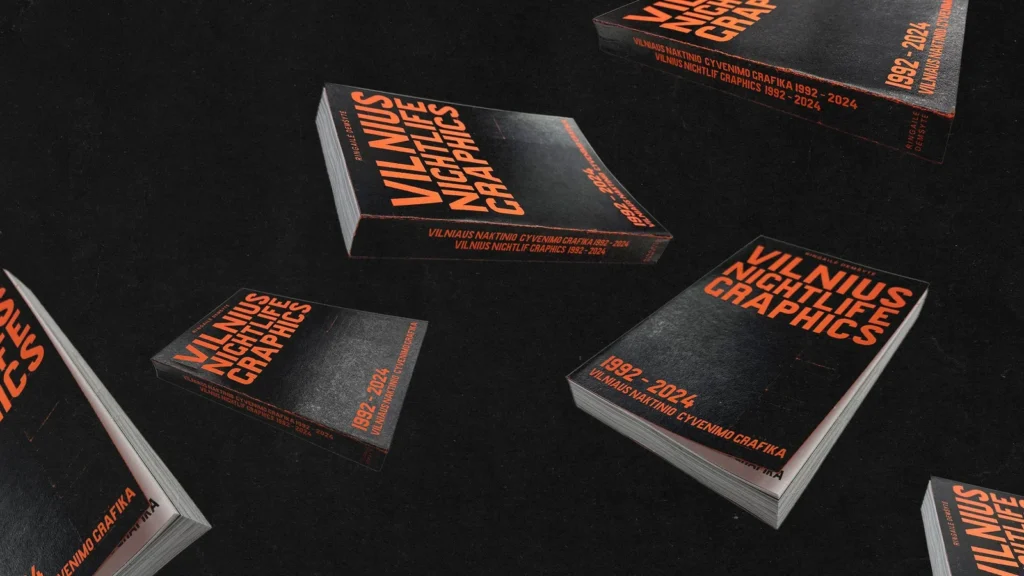
Vilnius nightlife is often remembered through sounds and places, but its memory is also quietly carried by posters, flyers, and visual communication. Graphic designer Ringailė Demšytė has spent the last several years systematically collecting these artifacts and interviewing the people who shaped the scene, ensuring their stories do not disappear into drawers and storage rooms. This work resulted in the independent publication “"Vilnius Nightlife Graphics 1992–2024"” — a book that combines interviews, maps, flyers, and posters into a living chronicle of the city's nightlife. We spoke with the author about her creative journey, the power of visuals, and the importance of community.
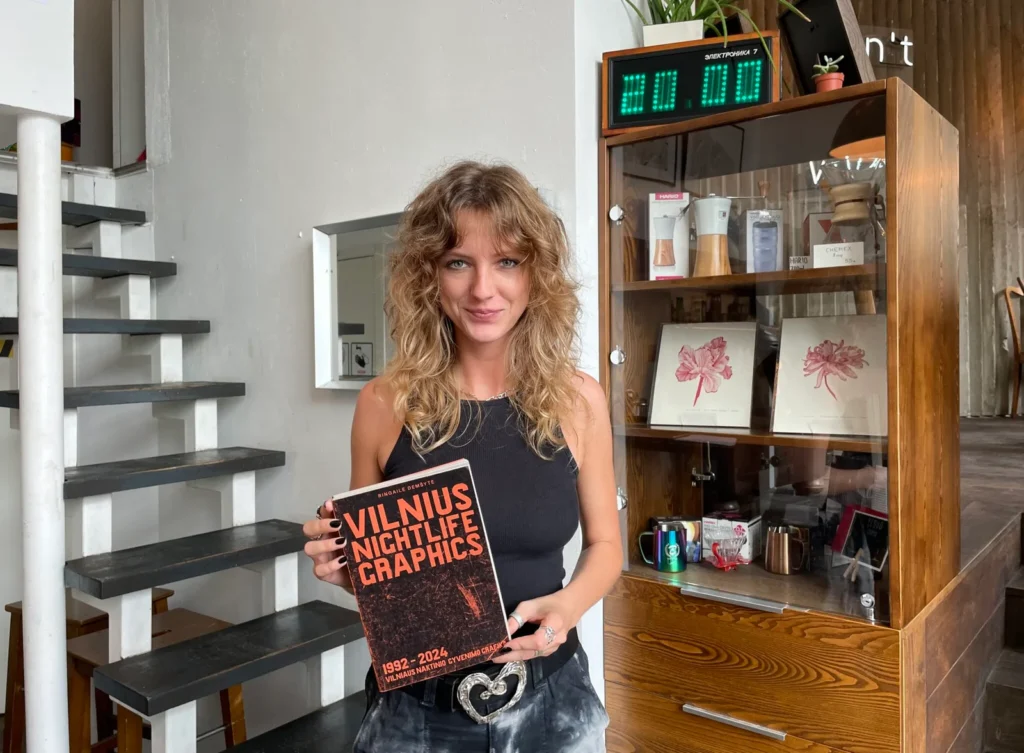
Tell us a little about yourself — what has your creative and professional path looked like leading up to this project?
Creating posters and visual communication for nightlife did not appear in my life by accident — it was something I consciously pursued. It all started with a desire to be part of a community and contribute to its growth from an early age.
Posters, although often perceived as temporary, seem to me to be an important form of communication. They reflect the issues, moods, and society of a specific period. Over the past few years, I have been actively working in graphic design, mostly within the nightlife scene: creating posters for events, clubs, and record labels in Lithuania and abroad. One of my biggest sources of inspiration has always been poster books. In them, you can see not only visual languages, but also the cultures, values, and histories of different eras. While flipping through my own collection, I naturally started asking myself: why don't we have a publication like this in Lithuania about nightlife and its visual evolution?
That is a good question! What inspired you to create precisely this kind of book — a collection of interviews, maps, flyers, and posters?
We have Juozas Galkus'’ “"History of the Lithuanian Poster,"” which explores the development of poster art from the mid-19th century to the present day. But there has never been a publication that serves as a living testimony of Lithuanian nightlife — for us and for future generations. There was also no consistently documented history of this scene: people's stories, experiences, and inspirations.
For me, posters have always been more than advertising. They tell stories. So I started building an archive, interviewing people from the scene, and eventually this book emerged.
What makes Vilnius nightlife special to you personally?
It is where I once found a home.
Why did you choose the period from 1992 to 2024?
After the restoration of independence, Vilnius nightlife began changing rapidly. There was a growing desire for freedom and new creative possibilities. In 1992, the first rave was held at the "Dainava" restaurant. It was legal, but still carried an underground aura — euphoric, radical, western. More than 30 years later, we now have a rich nightlife history, but it has only been documented in fragments.
You have been creating posters yourself for quite a long time and have worked with well-known clubs in Lithuania as well as creative collectives in the Netherlands. How do you recognize a "good" poster? Is there a formula, or is it more intuition?
For me, a good poster is always a balance between artistic value and a clearly communicated message. There is no single formula. A lot comes from intuition, but what matters most is that the poster not only catches attention, but also becomes something you would want to keep as an artwork. I like it when a poster becomes an artefact you could confidently hang on your wall.
You are publishing the book independently — what challenges have you faced? Were there any unexpected joys during the process?
The biggest challenge has been financing the publication, so together with Andrew Mikšys we launched a Kickstarter campaign and are truly hoping for community support. At the same time, I received a lot of encouragement: I wrote to hundreds of people, and even when they could not share archival materials, many responded enthusiastically, showed interest, or offered help. That sense of community became one of the most beautiful surprises throughout the process.
Was it difficult to collect so much visual material — especially from the early years after independence?
Yes, many flyers were simply lost or thrown away. But when I contacted DJs, organizers, and artists, they began searching through storage rooms, summer houses, and their parents' homes, pulling materials out of drawers and even from under beds. Meanwhile, I was digging through archives, looking through Facebook posts and articles. In the end, I managed to collect several thousand artifacts, and from them the foundation of these stories emerged.
If you could travel back in time — in which now non-existent Vilnius venue would you most like to spend a night?
My fascination with nightlife began in early adolescence: I moved from old-school rap to instrumental music, and then electronic music opened up to me — from ambient to techno. Very quickly I discovered different clubs, bars, and festivals. The biggest impression on me was left by Satta. Their festival promo videos and party communication were simply wow. I thought: "this is my place." But at the time I was only a twelve-year-old girl, still far from actually attending. Without a doubt, I would love to spend a night at the Satta bar.
In your opinion, how has the visual language of Vilnius nightlife changed over these 30+ years?
At the beginning, everything was very DIY — organizers printed flyers themselves, used magazine cut-outs, monochrome designs, Helvetica-style typography. Later, Photoshop appeared, budgets for designers emerged, quality improved, and much inspiration came from the West. A stronger generation of designers developed, visuals became more conceptual, and experimentation with typography, abstraction, and glitch aesthetics appeared. Clubs began forming their own identities, while flyers tried to stand out through formats, sizes, and colors.
With the rise of social media, visuals became more standardized — square posts, stories, banners — making it harder to stand out in a saturated environment. Still, today the visual language remains highly diverse: some return to rough handmade aesthetics, while others create polished work using 3D or AI.
Is this book more about nightlife itself or about its visual culture?
Since I am a visual artist myself, the book is primarily focused on visual culture. But through that, the scene itself naturally reveals itself as well.
What projects do you envision for the future — perhaps a continuation or an exhibition?
I have many ideas. I am interested in communication within the music industry in a broader sense — not only posters, but also vinyl records, cassettes, and different genres. I would like to explore not only Vilnius, but all of Lithuania. This time I limited myself to Vilnius because it is the first project of this kind, and there was already so much information that it was sometimes difficult to manage. But in the future I would definitely like to look at earlier periods and explore what visual communication looked like before independence.
Where and how will people be able to purchase "Vilnius Nightlife Graphics. 1992–2024"?
We are publishing the book independently through Kickstarter — this is the first opportunity to purchase it. Later, it will be available online and in various physical locations around Vilnius. Community support is extremely important: by contributing to the publication, people will not only receive the book first, but also help preserve more than 30 years of Vilnius nightlife history.
We sincerely thank Ringailė Demšytė for the conversation and warmly encourage everyone to support the campaign financing the publication of the book. More information can be found here.